Any facility.
Complete intelligence.


Learn 8 building maintenance strategies that move teams from reactive to preventive operations using integrated platforms and facility intelligence.

A well-run building doesn't announce itself. The lights stay on, the air feels right, and the people inside can do their jobs without thinking about the infrastructure keeping them comfortable. That invisibility is the actual goal.
When building maintenance is working at its best, work orders get logged before occupants notice a problem. Preventive checks run on schedule and generate records that hold up under audit. Technicians know exactly where an asset is and what its service history looks like. Across multiple sites, a single view shows what's been completed, what's overdue, and where attention should go next.
The data flows steadily, and the team acts on it. There's no scramble to piece together information from four different systems before a review. Building performance across sites becomes readable in the same language, using the same metrics. That consistency across sites, teams, and asset types is what separates a maintenance operation that manages risk from one that quietly creates it.
Reactive maintenance feels manageable until something expensive breaks. Then the full cost becomes visible: emergency contractor rates, occupant disruption, and the kind of reputational exposure that gets escalated to leadership before a work order is even raised.
Up to 30% of the energy consumed by HVAC systems is routinely wasted, largely due to poor maintenance practices and the absence of real-time performance monitoring.
IFMA Facilities Management Journal
That number compounds across a multi-site portfolio. HVAC maintenance for commercial buildings is often the single largest line item in a facilities budget, and when equipment runs in a degraded state without detection, the waste is baked into operating costs long before a fault is formally logged.
The deeper problem isn't the breakdowns themselves. It's the information gap that makes them inevitable. Work orders in one system, asset registers in another, HVAC logs somewhere else, and a spreadsheet someone built three years ago that nobody fully trusts. Building maintenance tracking software can close that gap, but only when the underlying data is connected and current.
Buildings managed on yesterday's information are, in most cases, more expensive to run than they need to be.
Eight distinct maintenance strategies shape how facility teams approach building upkeep, and knowing which one fits a given situation matters more than applying any single approach uniformly.
| Type | Definition | Trigger | Best Use Case | Pros | Cons |
|---|---|---|---|---|---|
| Reactive | Fix it after it breaks | Equipment failure | Low-criticality, easily replaced assets | Low planning overhead | High emergency cost; occupant disruption |
| Preventive | Scheduled maintenance on a fixed calendar | Time interval | HVAC, lighting, elevators | Reduces unplanned failures | May service equipment that doesn't need it |
| Corrective | Restore equipment after a sub-standard state is detected | Identified degradation | Assets that degrade gradually | Addresses real issues before full failure | Requires monitoring to detect degradation |
| Condition-based | Maintenance triggered by live sensor readings | Real-time data threshold | HVAC, chillers, electrical systems | Avoids unnecessary service intervals | Depends on sensor infrastructure |
| Predictive | Uses historical and live data to forecast failure | Data-driven anomaly | High-value, high-risk assets | Minimizes unplanned downtime | Requires data history and analytical capability |
| Reliability-centered | Matches maintenance strategy to each asset's failure mode and operational consequence | Risk and failure analysis | Complex, multi-system facilities | Optimizes resources across asset types | Intensive to implement; requires expertise |
| Risk-based | Prioritizes maintenance by consequence of failure, not just likelihood | Risk assessment | Regulated environments; life-safety systems | Focuses effort where failure costs most | Needs a robust risk-scoring framework |
| Emergency | Immediate response to an unplanned critical failure | Safety or operational crisis | All building types | Limits immediate damage | Reactive by nature; expensive |
Most enterprise facilities use a mix of several of these, calibrated to asset criticality and available data. The question worth asking is which combination reflects the current operation, and which combination the building actually wants.
Decision matrix. Which strategy fits your situation?
| Asset criticality | Data availability | Budget flexibility | Recommended starting point |
|---|---|---|---|
| Low | Low | Low | Reactive with documented thresholds |
| Low | High | Low | Condition-based for monitored assets |
| Medium | Low | Medium | Preventive on a defined schedule |
| Medium | High | Medium | Condition-based or corrective |
| High | Low | High | Preventive with reliability-centered planning |
| High | High | High | Predictive with risk-based prioritization |
| High | High | Low | Reliability-centered with triage logic |
Advanced building maintenance operations don't reach predictive capability overnight. The more useful move is to identify the highest-criticality assets first, assess what data already exists, and build from there. A building maintenance list organized by asset risk and data readiness does more practical work than any abstract maturity model.
For office building maintenance and industrial building maintenance alike, the starting point matters less than having a clear line of sight to where the program is heading. Building automation maintenance, when it draws on real-time sensor data, tends to accelerate that journey significantly because it removes the information gap that keeps so many facilities locked into patterns they've long outgrown.
Shifting from reactive to preventive maintenance changes how the work feels before it changes anything measurable. Field technicians spend less time responding to emergencies and more time following a schedule they can plan around. That matters because reactive work carries costs that rarely appear on a single line item: emergency contractor rates, overtime, and complaints that find their way up to senior leadership before anyone has a chance to explain what happened.
The more measurable outcomes come later, and they're significant. AI-driven forecasting of usage patterns across building systems has been shown to increase operational efficiencies by up to 30 percent (Market Research Future). A single coordinated HVAC initiative, where AI was deployed to manage system performance across a school portfolio, cut CO2 emissions by 205 tonnes (IFMA Facilities Management Journal). These aren't numbers from ideal conditions. They're what happens when data that was previously scattered and manual gets organized into something a team can actually act on.
For workplace experience leads, the change shows up differently. When a fault is logged and resolved before an occupant notices it, that occupant's relationship with the building stays neutral, which is exactly where it should be. Occupant satisfaction rarely improves because something was spectacular. It holds steady because nothing went wrong.
A smarter maintenance model, applied consistently across a multi-site portfolio, is mostly in the business of preventing the quiet erosions that compound over months before anyone thinks to trace them back to maintenance.
A building maintenance management system is a centralized platform that connects work orders, asset records, equipment logs, and service requests into a single operational layer, so that the people responsible for a building's upkeep are working from the same current picture rather than reconciling between four separate tools at the end of each day/week/month. The integration problem it solves is more structural than it sounds. Most enterprise facilities have a building management system handling environmental controls, a separate CMMS or spreadsheet tracking asset histories, energy meters reporting into their own portal, and service requests arriving through email or a ticketing tool that nobody loves. Each of these sources holds useful data. None of them talk to each other by default.
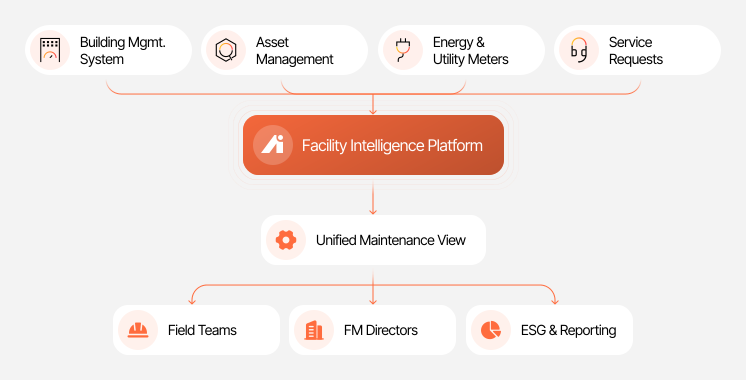
Data from disparate building systems converges into one platform layer, giving facility teams a shared view rather than a patchwork of separate records.
When those sources feed into a vendor-agnostic platform, the practical result is that a fault flagged by an HVAC sensor can generate a work order, route it to the right technician, and log the resolution against the asset's maintenance history, without anyone manually transferring information between systems. Insights published from Acrex India 2026 pointed to exactly this kind of integration as the gap between HVAC systems that perform well over time and those that degrade quietly. A well-configured building management system becomes considerably more useful when its data is connected to the maintenance layer rather than sitting in isolation.
Not every building system carries the same risk when neglected, and the case for focused maintenance spend is stronger when it's built around consequence rather than convention. The table below organizes the primary systems by the frequency their upkeep typically requires and what a lapse in that schedule actually costs.
| Building System | Recommended Frequency | Primary Risk of Neglect |
|---|---|---|
| HVAC (filters, coils, controls) | Monthly checks; full service quarterly | Energy waste, poor IAQ, premature equipment failure |
| Electrical systems (panels, wiring, emergency lighting) | Quarterly inspection; annual thermographic survey | Fire risk, unplanned outages, compliance exposure |
| Plumbing (pipe inspection, water treatment, backflow) | Bi-annual; continuous monitoring for large sites | Legionella risk, water damage, regulatory non-compliance |
| Fire safety (sprinklers, alarms, suppression systems) | Monthly visual checks; semi-annual full test | Life-safety failure; significant legal and insurance liability |
| Elevators and vertical transport | Monthly; per local regulatory schedule | Injury risk, unplanned shutdown, compliance failure |
| Building envelope (roof, glazing, seals, drainage) | Bi-annual inspection; post-storm checks | Water ingress, structural deterioration, energy loss |
| Lighting systems | Quarterly checks; sensor calibration annually | Occupant productivity loss, energy inefficiency |
| Access control and security systems | Quarterly review; firmware updates as released | Security vulnerability, compliance gaps |
HVAC maintenance for commercial buildings deserves particular attention here. It's typically the largest single consumer of energy in an office building and the system where monitoring pays back fastest. Heating energy at one multi-site educational portfolio dropped by 4 percent within five months of deploying AI-assisted management (IFMA Facilities Management Journal), which is a meaningful reduction for any portfolio running hundreds of units continuously.
A building maintenance list organized this way, by system, frequency, and consequence, gives FM managers a prioritization argument that's legible to finance and leadership. It also makes the case for building automation maintenance visible: when sensors are monitoring these systems continuously, the maintenance schedule becomes responsive rather than fixed, and the resources spent on servicing go where the data says they're needed.
Commercial building maintenance operations work best when the reporting structure is designed for the organization it actually serves, not the ideal version of it. That means building visibility in layers: technician-level task completion at the operational base, site-level performance summaries one step up, and portfolio-level trends that give leadership what they need for ESG reporting, budget conversations, and risk review.
The practical components of a reporting structure that holds together across regions include:
The ESG dimension of this matters more than it used to. Facilities teams are increasingly being asked to demonstrate, not just estimate, the environmental outcomes of their maintenance practices. Energy consumption before and after an HVAC service, IAQ readings before and after a filter change, emissions data tied to specific operational decisions: all of this becomes available when the tracking structure is connected to the building's live data rather than assembled retrospectively.
Advanced building maintenance, at the portfolio level, is largely a data design problem. The question isn't whether the data exists. It's whether the reporting structure captures it in a form that travels from a field technician's mobile phone all the way to a VP's quarterly review without anyone having to rebuild it in the middle.
Whether an organization is evaluating a building maintenance company for outsourced delivery or comparing building maintenance management software for an in-house team, the decision criteria that matter most are structural, not cosmetic.
A useful evaluation checklist:
One point worth sitting with: commercial building maintenance services delivered through a platform with weak integration will generate the same data-silo problem the platform was supposed to solve.
Organizations that have managed their way through the early stages of preventive maintenance, and built some data discipline around it, tend to hit the same ceiling. The point solutions they adopted to solve specific problems don't talk to each other, and the effort required to synthesize information across them starts to cost more than the tools themselves save.
A facility intelligence platform fits here as the connective layer, not a replacement for what's already working. Capabilities like digitized checklists, centralized service requests, and asset management become considerably more useful when they draw from the same data that HVAC sensors, energy meters, and occupancy systems are already producing. The maintenance team gets one current picture instead of several partial ones.
The Apptimus platform is built around this idea. Rather than treating checklist compliance, service request resolution, and asset tracking as separate functions, it connects them into a single operational layer that sits above existing building systems without requiring those systems to be replaced.
Where the model becomes genuinely powerful for senior FM and real estate leaders is at the visualization layer. Digital twin software gives maintenance teams a live spatial view of asset locations, system dependencies, and active faults across a building or a portfolio. A technician can locate an asset, review its service history, and act on an alert from the same interface rather than cross-referencing a floor plan, a CMMS record, and a sensor dashboard separately. At the portfolio level, that same visualization layer gives leadership the evidence base for budget decisions, ESG reporting, and risk review without requiring anyone to manually reconstruct it.
This is what complete building maintenance management looks like when the data is finally organized: not more effort, but better-directed effort.
Building maintenance is the ongoing work required to keep a structure, its systems, and its assets in safe, functional, and compliant condition. It spans everything from scheduled inspections and preventive servicing to reactive fault resolution and long-term asset lifecycle management. In enterprise contexts, it typically covers HVAC, electrical, plumbing, fire safety, vertical transport, the building envelope, lighting, and access control across one or more sites.
Commercial building maintenance services generally include preventive maintenance schedules, reactive fault response, work order management, asset tracking, compliance checks, and increasingly, condition-based or predictive maintenance driven by sensor data. At scale, it also includes the reporting and audit documentation that support ESG obligations and regulatory requirements.
A building maintenance management system is a platform that centralizes work orders, asset records, maintenance histories, and service requests into a single operational layer. It replaces disconnected spreadsheets and siloed tools with a shared, current view that field technicians, FM managers, and senior leaders can all act on. When connected to a BMS or sensor infrastructure, the system can generate alerts and work orders automatically based on live building data.
Frequency depends on the system. HVAC typically requires monthly filter checks and quarterly servicing. Electrical systems benefit from quarterly inspection and an annual thermographic survey. Fire safety systems need monthly visual checks and semi-annual full tests. The building envelope should be reviewed bi-annually and after significant weather events. Life-safety and high-criticality systems generally warrant more frequent attention, and local regulatory schedules may set minimum requirements regardless of condition.
The most practical starting point is identifying the highest-criticality assets, assessing what monitoring data already exists, and building a maintenance schedule around consequence rather than convention. Building maintenance tracking software helps by creating the audit trail and close-out records that make a preventive program visible and adjustable. The shift rarely happens all at once; it tends to consolidate one system or site at a time, with data quality improving as the program matures.
What most organizations discover somewhere in that process is that the bottleneck was never the intention to do preventive maintenance. It was having the information, in one place, at the right moment, to act on it.
Privacy is important to us, so you have the option of disabling certain types of storage that may not be necessary for the basic functioning of the website. Blocking categories may impact your experience on the website. More information