

Any facility.
Complete intelligence.


Lighting automation delivers energy savings, but connected facility data unlocks real building intelligence. See how to future-proof your investment.


Modern commercial buildings often carry more sensing capability than their lighting systems reflect. A facility can have occupancy data, a building management system, and a half-dozen connected platforms, and still illuminate empty floors for hours because no one has tied the configuration together.
Lighting automation addresses that gap directly. Occupancy data, daylight conditions, zone schedules, and connected controls can be combined so that how a space is lit follows how it is actually being used, rather than defaulting to fixed schedules set years ago and rarely revisited.
For facility and workplace leaders, the value extends further than switching lights on and off automatically. When lighting controls are connected with the systems already managing a building, teams gain clearer visibility into energy consumption, more consistent operations across zones and sites, and a way to bring lighting into a broader performance strategy rather than treating it as a separate problem.
The question is not whether lighting can be automated. It is whether the configuration, monitoring, and connectivity are in place to make that automation respond to what the building is actually doing.
For facility leaders, the question underneath lighting automation is a practical one: how much of a building's lighting is running when nobody needs it, and what does that cost across a year?
Lighting is one of the larger controllable energy loads in commercial buildings. That alone makes it a reasonable place to start for teams working on energy performance, but the case for automation extends past the electricity bill.
The operational case is different from the efficiency case, and worth separating.
When lighting runs on fixed schedules, it does not respond to how a building is actually being used. Occupancy shifts between floors, days, and sites in ways a preset timer cannot anticipate. Automated controls tied to occupancy sensing, daylight conditions, and zone-level logic can adjust to those shifts without requiring manual intervention each time conditions change. For teams managing multiple sites, that responsiveness is harder to achieve consistently through manual configuration alone.
The portfolio case is different again. When lighting operates as a standalone system, facility managers can see whether lights are on or off, but not much else. Connecting lighting controls to broader building management platforms makes consumption, zone behavior, and operational patterns visible in the same place as HVAC, space utilization, and energy data. That visibility supports planning rather than just monitoring.
These three things, efficiency, operational responsiveness, and portfolio visibility, tend to get bundled together in discussions of lighting automation. They are related, but each one has a different stakeholder and a different measure of success. Understanding which one a team is actually trying to improve shapes which controls and integrations are worth prioritizing.
That is where it helps to look at how the different components of a lighting automation system work together.
A commercial lighting automation system connects inputs such as occupancy sensors, daylight sensors, time-based schedules, dimming signals, and manual overrides through a central lighting control layer. That layer uses these inputs to determine how lighting should respond across different zones of a building.
The control layer and the software that manages or analyzes it are separate things. Platforms like Apptimus sit above the underlying lighting system, working with whatever interfaces that system exposes. What those interfaces can do varies by installation, which matters when an existing building is involved. Retrofit is often possible, but compatibility depends on the hardware already in place and the functionality it makes available.
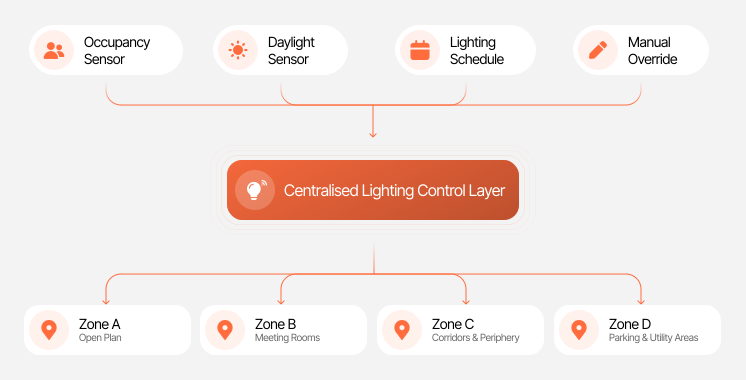
Lighting automation reduces energy consumption by acting on real conditions rather than assumptions. The mechanisms that produce the savings are distinct, and understanding them separately is what makes a business case concrete rather than approximate.
| Mechanism | How it reduces consumption |
|---|---|
| Occupancy-based control | Lights dim or switch off when occupancy sensors detect no presence, eliminating energy use during unoccupied periods at the zone level |
| Daylight harvesting | Daylight-responsive lighting reduces artificial output when natural light is sufficient, smoothing consumption across perimeter zones through the day |
| Scheduled dimming | Lighting schedules set graduated output during lower-activity periods (early morning, lunch, end of day) rather than holding full brightness across the operating window |
| Zoning | Dividing a floor or building into independent lighting zones means a vacant wing does not run at the same level as an occupied one |
| Dimming curves | Graduated dimming rather than binary on/off extends lamp life and avoids energy spikes at full power |
Advanced lighting control systems provide savings of approximately 29% over the installed base of lighting controls, according to the Northeast Energy Efficiency Partnerships (source). That figure grows substantially when lighting connects to other building systems. Connected lighting technologies integrated with HVAC, occupancy data, and energy management can provide an additional 50% or more in savings beyond what standalone lighting controls achieve (Better Buildings Solution Center). The difference between those two numbers is essentially the argument for integration rather than point-solution deployment.
Lighting automation can work with what a building already has. For most enterprise facilities, that practical fact is the deciding one.
Lighting automation can often be extended in existing buildings, but the scope depends on the installed infrastructure. A facility intelligence layer can connect compatible lighting controls, sensors and building management systems through available interfaces and supported protocols. Where existing hardware lacks the required functionality, additional controllers, gateways, wiring changes or hardware upgrades may be necessary.
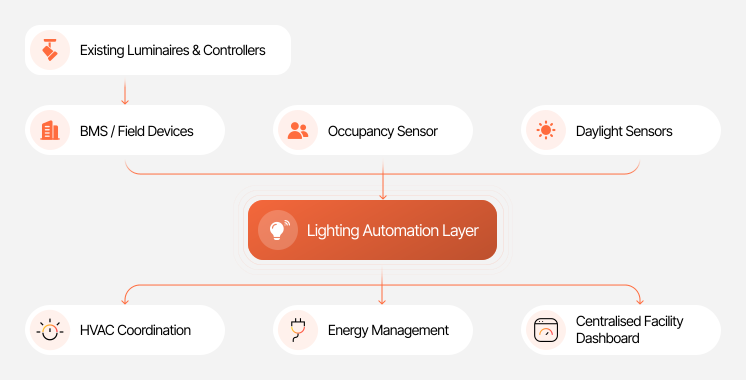
A vendor-agnostic integration layer connects compatible lighting controls with broader building systems, extending the value of existing infrastructure where supported.
HVAC coordination is one of the more direct gains from this architecture. When a building automation system can see that a zone is unoccupied, both lighting and conditioning can respond together rather than independently running schedules that were never synchronized. Occupancy data shared across systems also improves space utilization reporting, which feeds back into longer-term planning decisions. The relationship between connected HVAC and lighting management is explored in more depth through Acrex India 2026 HVAC insights, which covers how building teams are approaching that integration in practice.
A vendor-agnostic approach matters here because enterprise estates rarely run a single lighting hardware standard across all sites. A commercial lighting control system that depends on proprietary hardware can make retrofitting existing buildings significantly more expensive or complex.
For an FM director managing a multi-floor corporate campus, the operational shift from a smart lighting system is less about the energy bill month to month and more about what becomes visible that was not before.
Centralized lighting control gives facility teams a live picture of zone status across the building: which areas are lit, at what level, and whether any zone is behaving outside expected parameters. An alert on a corridor that has run at full brightness for fourteen hours without detected occupancy is a maintenance signal, not just an anomaly. The team can check the sensor log, confirm whether occupancy detection has failed or a schedule override was left active, and close the issue the same day. Without that visibility, the fault might run for weeks before it appears on an invoice.
Multi-site estates gain something additional. When every site runs through a consistent enterprise lighting control layer, operations leads can compare performance across locations, identify which buildings are drifting from baseline, and apply a configuration change centrally rather than coordinating separate vendor visits at each property. That consistency is difficult to achieve with site-specific lighting schedules and disconnected control systems.
The reduction in manual monitoring effort is quieter but real. Facility teams that previously relied on walkthrough checks or end-of-month energy reports to identify inefficiencies can use operational alerts to identify exceptions earlier and prioritise interventions where they are needed.
The strongest commercial lighting automation systems share a set of qualities that show up consistently in enterprise deployments: they work with what the building already has, they can grow as the portfolio grows, and they surface data that facility teams can actually use. The table below organizes the core evaluation criteria.
| Evaluation criterion | What to look for |
|---|---|
| Integration compatibility | Does the system communicate over standard protocols such as BACnet, MQTT, or REST? Protocol support is a starting point, not a guarantee. Verify whether the system has been tested with the specific BMS versions, sensor models, and luminaire controllers already installed, and ask what integration gaps the vendor has encountered in similar estates. |
| Automation depth | Does the system support occupancy-based control, daylight-responsive lighting, zone-level dimming, scheduling, and manual override in combination, not as separate options? |
| Data visibility and reporting | Can facility teams access zone-level energy consumption, operating status, and anomaly alerts in a centralized view? Equally important: who owns that data, in what format can it be exported, and what happens to historical records if the contract ends? |
| Deployment architecture | Does the system run on cloud infrastructure, on-premise servers, or a hybrid arrangement? Each carries different implications for IT governance, data residency, latency during connectivity loss, and what the organization controls if the vendor relationship changes. |
| Scalability | Can the same system architecture extend across additional floors, buildings, or sites without a separate implementation at each location? |
| Retrofit readiness | Can the system layer above existing infrastructure, or does it require replacing luminaires, controllers, or wiring? Deployment complexity determines real cost more than license fees. |
| Security and interoperability | Does the platform meet enterprise security requirements and IT approval criteria? Can it share data with HVAC, energy, and space management systems, and under what access controls? |
| Total cost of ownership | Beyond installation, what do ongoing monitoring, configuration changes, and multi-site management cost, and who carries them? |
Procurement teams often evaluate on upfront hardware cost and miss the longer-term question of what the system costs to manage across a large estate. A lighting control platform that requires local engineering visits for each configuration change is less scalable than one that supports centralized policy management, and that difference rarely surfaces in a vendor demo.
Lighting data becomes substantially more useful once it is part of a shared building data environment rather than sitting in its own reporting silo. When occupancy sensors feeding a lighting automation system also share their readings with HVAC scheduling and space utilization analytics, each layer benefits from a richer signal than it would generate alone.
The pattern that emerges from connected building data looks different from what any point solution produces. A floor that shows consistent lighting energy at 80% output from 7am to 8pm, combined with occupancy readings showing 30% utilization most afternoons, is worth examining, though the explanation could be scheduled safety requirements, zone configurations that predate the current tenancy, or HVAC coordination logic running independently of actual presence. What the combined signal does is surface the question, which is more than either system would raise on its own.
Investigating this pattern can help facility teams determine whether lighting schedules need adjustment, HVAC coordination should be reviewed, or space utilization assumptions need revisiting. The combined data provides a starting point for these decisions, rather than proof of inefficiency on its own.
Platforms like Apptimus are built around exactly this integration, pulling lighting status, energy consumption, and occupancy data into a common layer alongside HVAC, space management, and asset monitoring. The lighting investment does not stand alone; it feeds a broader operational picture that creates additional value across facility operations over time.
The near-term development in building lighting automation is not about more dramatic control features. It is about tighter data sharing between systems that have historically operated independently.
Predictive maintenance through lighting behavior is one area where this is starting to show up in practice, though it depends on a few things being in place. A luminaire dimming erratically before it fails can produce a detectable signature in consumption data, but surfacing that pattern reliably requires consistent telemetry, an analytics layer configured to look for it, and a maintenance workflow that can act on the alert. Where those conditions exist, facilities teams have used it to reduce unplanned outages rather than simply reacting after the fact. Where they do not, the data exists without the interpretation. Occupancy intelligence is also developing in this direction, with lighting sensors contributing to portfolio-level space utilization analysis rather than just triggering a zone response, again depending on how the data is aggregated and who is responsible for reading it.
Centralized policy management at the portfolio level is a similar story.
The capability to propagate a configuration standard from headquarters across multiple sites without individual vendor visits is technically achievable in some enterprise platforms, though it requires compatible infrastructure at each site and enough access control to make a remote change reliably. For FM directors managing estates across several countries, that kind of consistency would address a governance question as much as an operational one. How far along any given estate is toward that depends considerably on what was installed and when.
For enterprise decision-makers, the practical implication is that an automated lighting system chosen today should be evaluated not just on what it controls now, but on what data it contributes and which systems it can connect to over time. Lighting system integration should therefore be evaluated as part of a broader facility strategy. Buildings that treat lighting as a connected operational layer, rather than a standalone energy project, tend to get more durable returns from the investment, and more usable insight from the data it produces.
Privacy is important to us, so you have the option of disabling certain types of storage that may not be necessary for the basic functioning of the website. Blocking categories may impact your experience on the website. More information

