Any facility.
Complete intelligence.


India hosts 1,700+ GCC employing 1.9 million professionals and generating $64.6 billion in annual revenue, with projections pointing toward $100 billion+ by 2030.


A Global Capability Centre (GCC) is an entity established by a multinational corporation in another country to perform strategic business functions: technology development, data analytics, finance operations, research, and increasingly, AI and machine learning. Unlike outsourced service providers, GCCs are wholly owned subsidiaries. The parent company retains direct control over talent, intellectual property, and operational standards.
India's GCC ecosystem has grown intao the largest of its kind anywhere. Over 1,700 GCCs now operate across the country, collectively employing 1.9 million professionals and contributing $64.6 billion in revenue during FY24, according to NASSCOM-Zinnov research. By 2030, that number is expected to cross 2,500 centres, with the workforce reaching 2.8 million and revenue surpassing $100 billion. Sixty-five per cent of Fortune 500 companies already run Indian GCCs.
GCC occupiers claimed 38% of all Indian office leasing in 2025, absorbing a record 31.3 million sq ft of workspace. That figure grew 70% year-on-year in Q1 2025 alone, with 88% of new space being green-certified. GCC deal volume now exceeds the combined space commitment of India's domestic IT services sector and co-working operators.
India offers a large, skilled workforce, significant cost advantages, and an increasingly mature digital infrastructure. What has accelerated the momentum is the policy environment. The Union Budget 2025 introduced India's first national GCC policy framework, signalling that the central government now treats capability centres as a distinct economic category. State governments have moved faster still. Karnataka's "Beyond Bengaluru" initiative targets 500 new GCCs and 3.5 lakh jobs by 2029 with a $50 billion revenue goal. Maharashtra, Gujarat, and several other states have followed with dedicated GCC policies offering capital subsidies, rental assistance, and payroll incentives.
JP Morgan is building Asia's largest GCC in Mumbai's Powai district: 2 million sq ft, capacity for 30,000 employees, completion targeted for 2029. AstraZeneca committed ₹166 crore to expanding its Bengaluru R&D centre. These are not speculative announcements. They are construction timelines and capital expenditure filings.
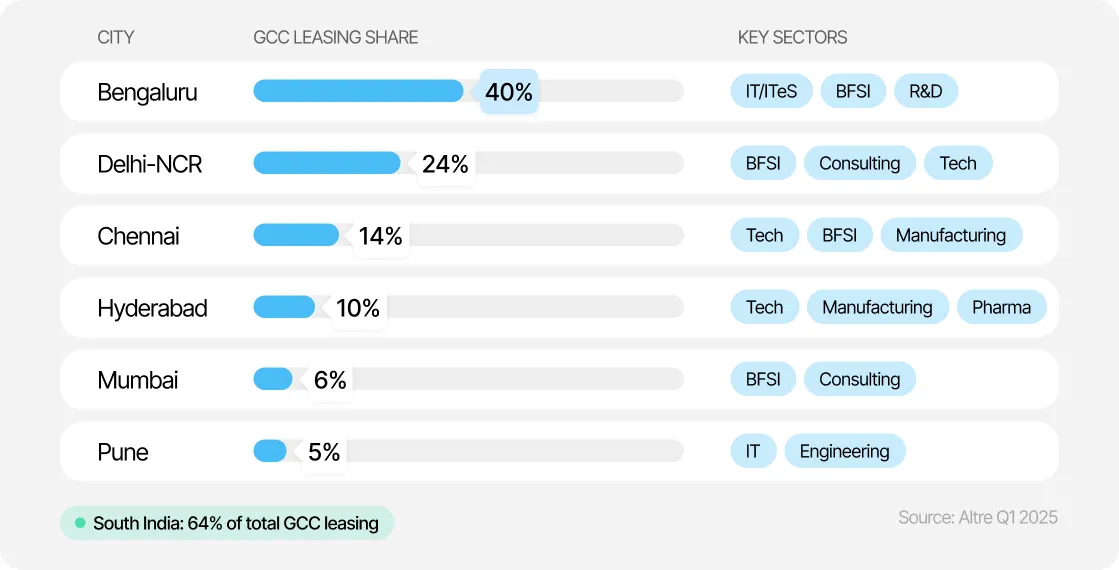
Bengaluru dominates, but not by as wide a margin as it once did. The city still accounts for 40% of all GCC office absorption, anchored by its concentration of IT, BFSI, and R&D centres (roughly 900 GCC units). Delhi-NCR follows at 24%, drawing consulting and financial services operations. Chennai (14%) and Hyderabad (10%) round out South India's hold on the market. Together, southern cities represent 64% of all GCC space commitment in India.
Mumbai (6%) and Pune (5%) occupy smaller but growing shares, with Mumbai's strength in BFSI and Pune's engineering talent base attracting specialised centres. The more interesting story is at the edges. State-level GCC policies in Gujarat and Maharashtra are designed specifically to pull new entrants toward cities that were not on the shortlist five years ago.
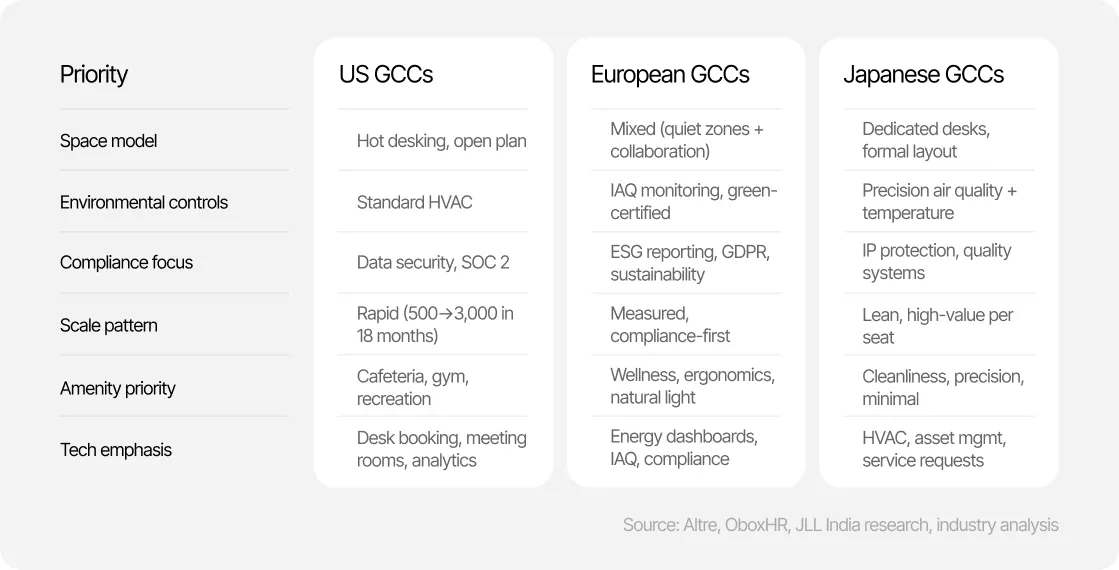
US-headquartered corporations account for 55–60% of India's GCC base and roughly 70% of new demand. The operational DNA of these centres tends to follow a recognisable pattern: open-plan layouts, hot desking as a default, high meeting-room density, and campus-style amenities (cafeterias, fitness centres, recreational zones). A US GCC scaling from 500 to 3,000 employees in 18 months is not unusual, which means the facility infrastructure needs to support rapid reconfiguration without lengthy procurement cycles. JP Morgan's Powai campus, designed to house 30,000 people across 2 million sq ft, is the logical endpoint of this scale-first mentality.
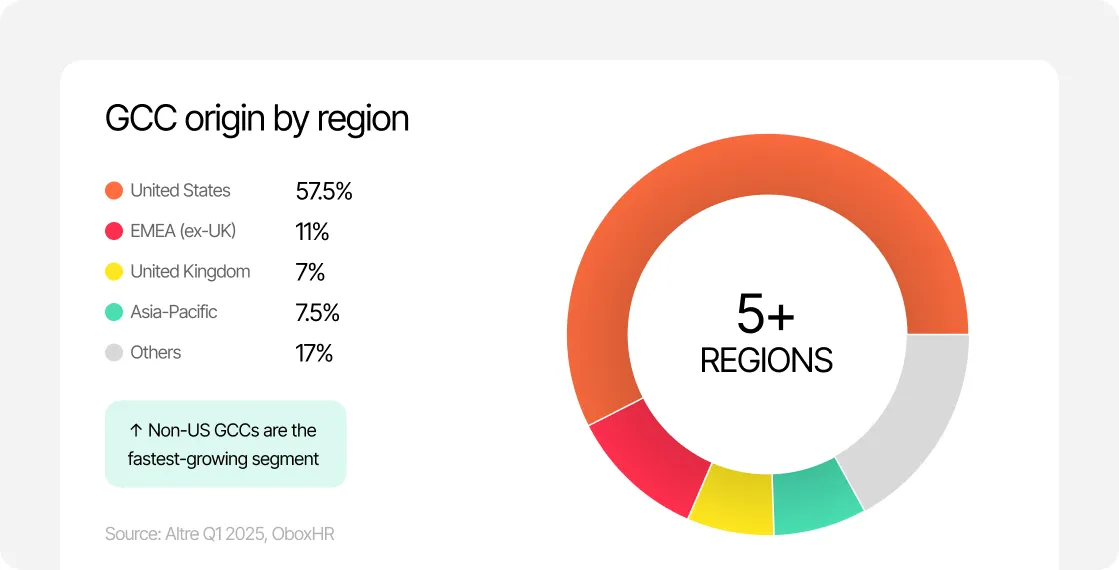
European GCCs (excluding the UK) represent 15–20% of the base but punched above their weight in Q1 2025, capturing 28% of leasing activity. Germany alone is growing at 6.5% CAGR. Sustainability is not a reporting checkbox for these centres; it is an operational requirement. ESG dashboards, indoor air quality monitoring, green-certified buildings, and dedicated quiet rooms for focused work reflect workplace regulations that European parent companies must demonstrate compliance with globally.
Then there is the Asia-Pacific contingent, led by Japan. APAC GCCs have grown 65% over five years, with Japan-origin centres expanding at a 10.6% CAGR. The workplace philosophy could not be more different from the American model. Dedicated desks rather than hot desking. Formal spatial layouts that reflect organisational hierarchy. Precision in environmental controls, particularly air quality and temperature consistency. Where US GCCs optimise for speed and European centres optimise for compliance, Japanese facilities tend to optimise for stability: long-term employee retention, lean operations, and meticulous space utilisation.
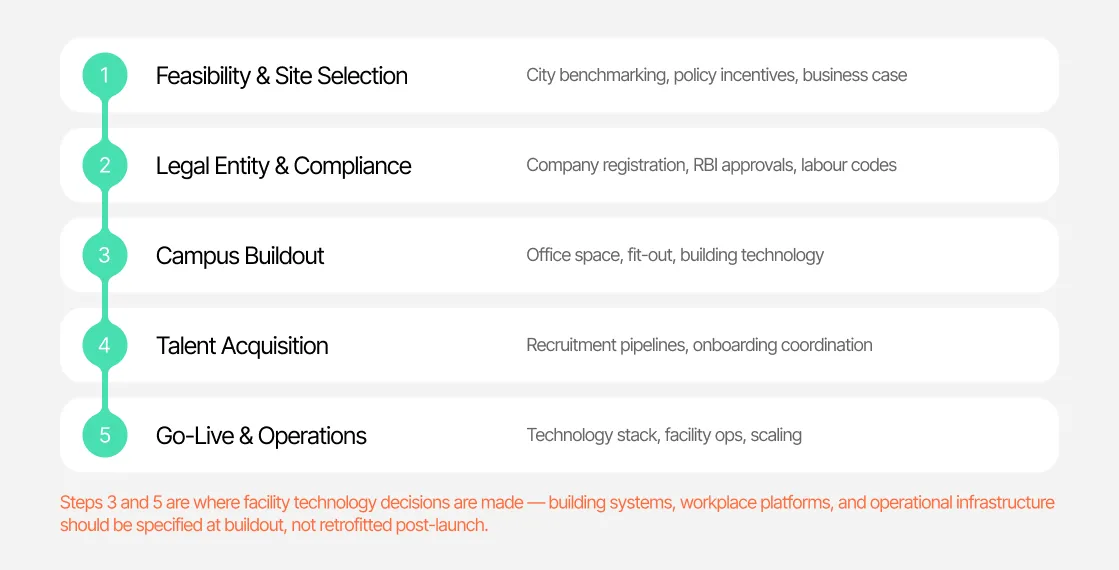
For a multinational moving from boardroom approval to operational GCC, the path from entity registration to employee badge-swipe typically spans 12 to 18 months. Five broad stages define the journey.
1. Feasibility and site selection. Before any legal filing, the parent company benchmarks cities against its talent needs, real estate costs, and sector cluster. A financial services firm gravitating toward Mumbai faces a different calculus than a European engineering group evaluating Pune or Chennai for R&D depth. State-level incentive policies factor directly into the business case: Maharashtra offers capital subsidies of up to 20%, while Gujarat's 2025–30 framework provides salary reimbursements and social security support.
2. Legal entity and compliance. Incorporating a private limited company under Indian law, securing RBI approvals for foreign direct investment, and registering under applicable labour codes. The national GCC policy framework introduced in the Union Budget 2025 standardised incentive structures that simplify this step for new entrants.
3. Campus buildout and infrastructure. Securing office space (increasingly green-certified, given that 88% of new office stock in Q1 2025 carried sustainability ratings), fitting out floors, and provisioning building technology. This is where facility systems, from HVAC and energy metering to access control and occupancy sensors, get designed into the campus rather than bolted on later. Karnataka's Beyond Bengaluru policy offers infrastructure support for GCCs expanding into tier-2 cities within the state.
4. Talent acquisition at scale. India's GCC workforce reached 1.9 million professionals in FY24, with the ER&D segment growing fastest. Recruitment pipelines for a 500-person launch often run in parallel with construction timelines, coordinating campus readiness with onboarding dates.
5. Go-live and operational maturity. The first 90 days after occupancy test whether the technology stack holds up under real usage. Meeting room booking systems, visitor management, parking allocation, cafeteria pre-ordering: these are not afterthoughts. They are the operational layer that determines whether 500 people can work productively from day one, and whether the facility team can scale to 3,000 without tripling headcount.
A VP of Global Real Estate overseeing three Indian campuses across Bengaluru, Hyderabad, and Pune faces a specific kind of complexity. Each location has different floor plates, different occupancy patterns, different local compliance requirements. The parent company expects consolidated reporting. The employees expect their building to work.
Consider space intelligence. In a 2,000-seat campus running a hybrid model, actual daily occupancy might fluctuate between 55% and 85%. Without real-time occupancy data, the facility team either over-provisions (wasting energy on half-empty floors) or under-provisions (employees arrive to find no available desks). Occupancy analytics, desk allocation engines, and meeting room utilisation dashboards turn this from guesswork into a manageable operation. For a GCC expanding from one floor to four over 18 months, the ability to forecast space demand by team, by day, by building becomes a planning tool, not just a reporting one.
Building systems add another layer. HVAC accounts for a significant share of energy consumption in Indian commercial buildings, and GCC campuses in cities like Chennai and Hyderabad contend with extreme cooling loads for several months each year. Energy monitoring dashboards, automated lighting schedules, and indoor air quality sensors serve a dual purpose: they reduce operational costs and they generate the environmental data that European parent companies increasingly require for ESG disclosures. Where a German GCC might mandate IGBC or LEED compliance, the building management system becomes the evidence trail.
Visitor and access management is operationally simpler to describe but equally important at scale. A campus processing 200 external visitors daily alongside 1,500 employees needs pre-registration workflows, integrated entry systems, and attendance records that satisfy both security audits and labour compliance. Digital checklists for daily facility inspections, asset tracking for IT equipment across floors, service request portals that route a broken AC complaint to the right contractor within the right SLA: these are the facility operations layer that keeps a large campus functional without ballooning the operations team.
Then there is the employee-facing surface. Cafeteria management, parking slot allocation, indoor navigation for multi-building campuses, and a communication channel that reaches every occupant. For a GCC competing to retain engineers who could walk across the road to another technology campus, the daily experience of working in the building matters.
Most GCC facility teams manage these capabilities through separate vendors, separate dashboards, separate contracts. Platforms like Apptimus unify these five capability areas into a single operational layer, but regardless of the vendor approach, the underlying principle holds: a GCC campus that treats building technology as infrastructure (rather than as a collection of point solutions) will operate more efficiently as it scales.
A facility manager at a GCC with 4,000 employees across three buildings should not need to open four dashboards, export two spreadsheets, and email the HVAC vendor to answer a simple question about energy consumption. The next generation of facility platforms is closing exactly this gap: AI layers that sit across building systems and make them collectively intelligent.
Conversational interfaces are entering facility operations. Instead of building manual reports or switching between vendor dashboards, a facility head will ask "what's the occupancy trend on Floor 3 this month?" or "show me energy consumption by zone for Q1" and receive structured answers drawn from live sensor and system data. Behind these queries, AI normalises information from otherwise disconnected systems (HVAC, access control, energy metering, occupancy sensors) into a single analytical layer, making cross-system patterns visible for the first time.
Predictive maintenance is another area where the shift is already underway. Rather than waiting for an air handling unit to fail mid-July, when Bengaluru humidity peaks and HVAC loads are highest, AI models flag early signs of equipment degradation: rising motor temperatures, unusual vibration patterns, declining airflow efficiency. Maintenance teams respond to data, not emergencies.
For teams without technical training, AI-generated visual interfaces will offer intuitive ways to interact with zones, floors, and entire campuses. A facilities coordinator could monitor a digital twin of a building without understanding the protocols running underneath. Critically, these AI capabilities will need to operate within the regulatory frameworks that GCCs handling sensitive IP in pharmaceuticals, financial services, and semiconductor design require. The same platform architecture must serve a pharma cleanroom in Hyderabad, a data centre in Chennai, and a commercial campus in Gurugram without requiring separate technology stacks.
Industry projections point to 2,500+ GCCs operating in India by 2030, employing 2.8 million professionals and generating over $100 billion in annual revenue. As that footprint expands into tier-2 cities, across new building types, and into increasingly regulated industries, the operational complexity of managing these facilities will grow faster than the headcount.
The GCCs arriving today are not carbon copies of the ones established a decade ago. They represent a wider spread of origin cultures, each with distinct workplace expectations. They occupy buildings that must meet Indian green certification standards while satisfying a European parent company's ESG reporting requirements. They need facility platforms intelligent enough to handle predictive maintenance, conversational data queries, and cross-system compliance reporting simultaneously.
What separates the next wave of GCC facilities from the current one will not be location or talent access. Those advantages are well established. The differentiator will be how intelligently a building operates: how quickly it adapts to shifting occupancy, how accurately it predicts equipment failures, and how transparently it reports across regulatory regimes. The facility layer, long treated as a cost line, is becoming the infrastructure layer that determines whether a GCC can scale without friction.
"The facility layer, long treated as a cost line, is becoming the infrastructure layer that determines whether a GCC can scale without friction."
Kushal Chokhani, Co-Founder & CTO, Bluecoin IoT
A Global Capability Center is an offshore or nearshore operation owned and operated by a multinational company, as distinct from third-party outsourcing. GCCs handle functions ranging from IT and engineering to finance, HR, and R&D. Unlike outsourced service providers, a GCC operates under the parent company's brand, governance, and IP framework.
India hosts between 1,700 and 1,900 GCCs as of FY24, according to NASSCOM-Zinnov data. These centres collectively employ 1.9 million professionals and generate $64.6 billion in annual revenue. Roughly 65% of Fortune 500 companies now operate a GCC in India.
BBengaluru leads with approximately 40% of all GCC leasing activity, followed by Delhi-NCR at 24%, Chennai at 14%, and Hyderabad at 10%. Mumbai and Pune account for 6% and 5% respectively. South India collectively represents 64% of all GCC-related office leasing.
Costs vary significantly based on city, scale, and function. A 500-seat technology centre in Bengaluru will have different cost structures than a 200-seat finance operation in Pune. Key variables include commercial leasing rates (which range from Rs 45-120 per sq ft depending on city and grade), fit-out costs, technology infrastructure, and regulatory compliance. Several state governments now offer capital subsidies of up to 20% and salary reimbursement programmes to offset setup costs.
At minimum, a GCC requires systems for space management, environmental controls, access and security, and employee services. Meeting room booking becomes critical at scale because a 3,000-person centre with inadequate room allocation loses hundreds of productive hours weekly to scheduling conflicts. Indoor navigation matters in large campuses where new employees and visitors need to locate specific zones, labs, or collaboration areas across multiple floors and buildings. The technology stack should integrate these systems rather than running them as isolated tools.
Multi-building operations require a centralised platform that provides visibility across all locations without requiring physical presence at each site. Digital inspection software replaces paper-based checklists with standardised, auditable processes that a central facilities team can monitor in real time. The challenge intensifies when buildings sit in different cities with different municipal regulations, different HVAC requirements driven by climate variation, and different occupancy patterns. A unified platform normalises these variables so that a facilities head in Bengaluru can oversee operations in Hyderabad and Pune from a single dashboard.
GCC facilities in India must comply with multiple overlapping frameworks. These include the Bureau of Energy Efficiency (BEE) standards for energy consumption, National Building Code fire safety requirements, IGBC or GRIHA green building certifications (88% of new office space in Q1 2025 was green-certified), and state-specific labour and environmental regulations. For GCCs in regulated industries such as pharmaceuticals or financial services, additional data security and physical access controls apply. When evaluating facility technology vendors, it is worth checking whether the vendor itself demonstrates enterprise-grade compliance; Bluecoin's Trust Center, for instance, documents their certifications, security policies, and data handling practices.
AI in facility management is moving from pilot programmes into early production deployments. Conversational interfaces are enabling facility teams to query building data in natural language, retrieving occupancy trends or energy consumption patterns without building manual reports. Predictive maintenance models analyse equipment performance data to flag degradation before failure occurs, reducing emergency repair costs and unplanned downtime. AI-generated visual interfaces are making it possible for non-technical staff to interact with building systems intuitively, while unified reporting layers normalise data from HVAC, access, energy, and occupancy systems into coherent cross-building analysis. As these capabilities mature, the facility platforms that integrate AI natively will set the operational standard for the next wave of GCC campuses.
Setting up a GCC in India has never been easier in terms of policy support, talent access, and real estate availability. Where most organisations underinvest is the operational layer: the building systems, workplace technology, and facility intelligence that determine how well a campus actually runs once people show up.
Bluecoin works with global teams setting up and scaling GCC facilities across India, providing Apptimus, a unified, modular platform that covers space management, building controls, visitor and access systems, and facility operations. Whether the requirement is a single-floor R&D lab or a multi-city campus serving thousands, the platform adapts to the workplace culture, compliance regime, and building type.
If you are planning, building, or scaling a GCC facility in India and want to understand how facility intelligence fits into the picture, book a meeting with the Bluecoin team to explore what a smart facility setup looks like for your specific needs.
Privacy is important to us, so you have the option of disabling certain types of storage that may not be necessary for the basic functioning of the website. Blocking categories may impact your experience on the website. More information