




Any facility. Complete intelligence.

Get Apptimus Mobile
Space & Occupancy
Access & Security
Facility Operations
Energy & Environment
Facility Intelligence
Solutions
Discover key takeaways from Hong Kong International Lighting Fair 2026 and how connected lighting is shaping smarter facilities.

Lighting is moving beyond illumination. Across commercial buildings and modern workplaces, it is becoming an increasingly connected part of how spaces operate, respond and adapt to the people using them.
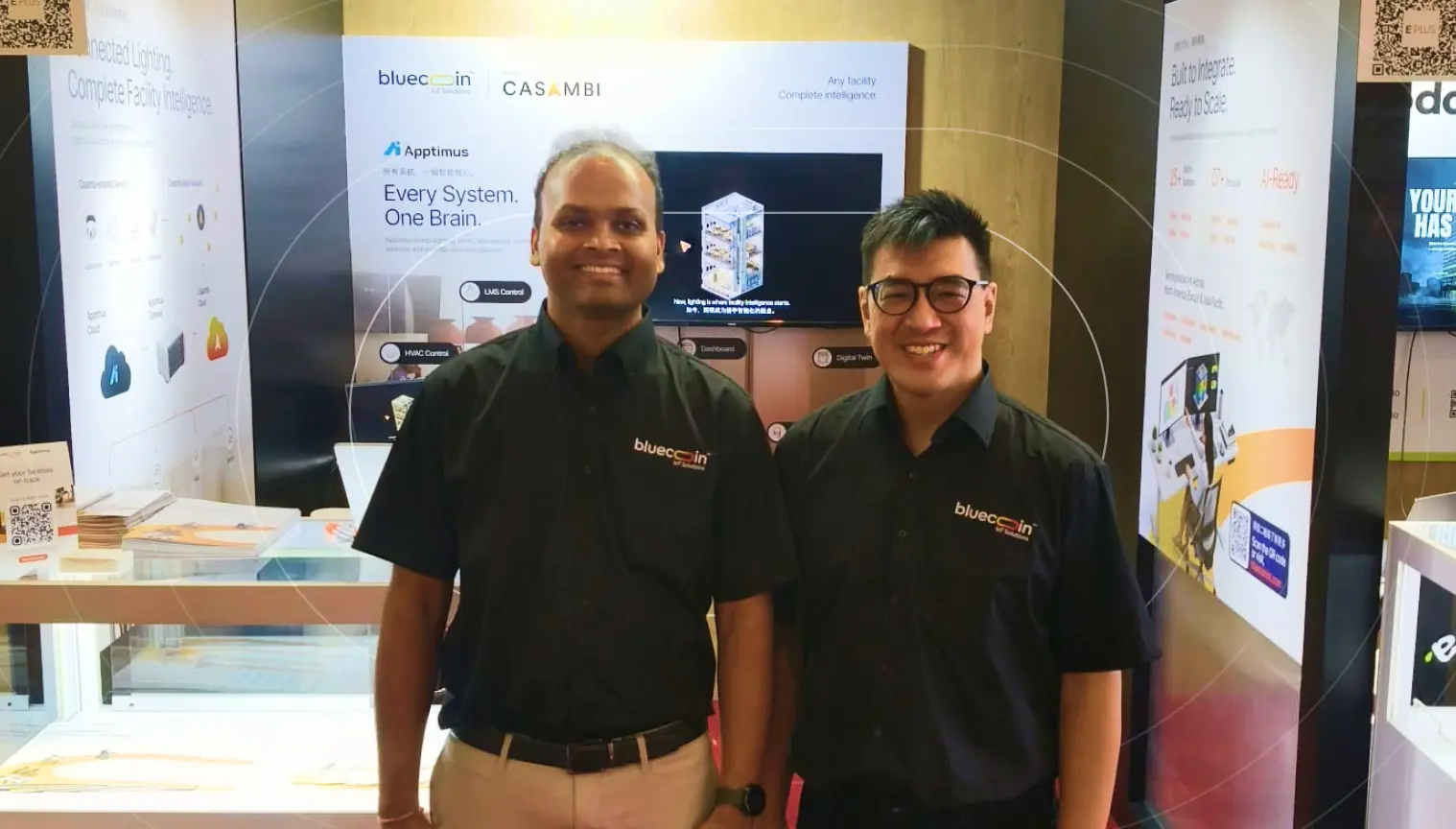
We attended the Hong Kong International Lighting Fair (Autumn Edition) 2026 from 27 to 30 October, participating alongside our technology partner, Casambi. Held under the theme Beyond Illumination, this year's event brought together lighting manufacturers, technology providers, designers and industry professionals to explore the next phase of lighting innovation.
The Hong Kong International Lighting Fair is an important international meeting point for the lighting industry. The 2026 Autumn Edition brought together manufacturers, technology providers and industry organisations under the theme Beyond Illumination.
One of the most relevant highlights was the Hall of Connected Lighting, which featured approximately 70 brands, including Casambi, Signify, TUYA and Viso Systems. The presence of these technology providers alongside industry organisations such as the DALI Alliance, Connectivity Standards Alliance and Zhaga Consortium reflected the growing importance of connectivity and interoperability.
One thing stood out from the direction of the event: the conversation around lighting is expanding. It is no longer limited to fixtures, brightness or design. Connectivity, wireless controls, automation and the ability to manage lighting as part of a wider building ecosystem are becoming increasingly important.
The shift is significant. Traditional lighting systems were largely designed around individual fixtures and control points. Connected lighting introduces another layer of possibilities, allowing luminaires, sensors, controllers and software to work together.
For commercial buildings, this means lighting can become more responsive to occupancy, daylight availability, room usage and operational requirements. It also creates opportunities to bring lighting data into broader building management and facility intelligence strategies.
"Lighting is often treated as a standalone system, but it doesn't have to operate in isolation. When it's connected with occupancy, room bookings and other workplace activity, it becomes much more useful to the people managing a building. That's where the real value of this integration lies."
Kushal Chokhani, Founder & CEO, Bluecoin IoT
For years, lighting decisions in commercial buildings largely revolved around illumination levels, energy consumption, fixture selection and installation costs.
Those considerations remain important. But as buildings become more connected, facility teams are asking a different set of questions.
Can existing lighting installations be automated without replacing the entire infrastructure? How easily can different lighting systems communicate with one another? Can lighting respond automatically to occupancy and daylight? And how can organisations monitor energy consumption across multiple locations?
These questions point towards a more integrated approach to lighting management.
Wireless lighting control is particularly relevant here. It introduces flexibility into how lighting systems are deployed, controlled and expanded. For organisations upgrading existing buildings, this can create opportunities to introduce automation without treating every retrofit as a complete infrastructure replacement.
The bigger challenge, however, is ensuring that connected lighting does not become another isolated technology system. Its real value emerges when the data and controls can contribute to the wider intelligence of a building.
Bluecoin IoT participated in the Hong Kong International Lighting Fair 2026 alongside Casambi, our technology partner in wireless lighting control.
The partnership brings together two complementary areas of building technology. Casambi's wireless lighting-control ecosystem enables flexible control and automation of lighting installations, while Bluecoin's Apptimus Facility Intelligence Platform brings lighting into the wider context of building operations.
At the core of this integration is Casambi's Bluetooth mesh technology, which connects lights, sensors, switches, and controllers into a single wireless network without requiring special wiring.
Through its integration with Apptimus, organizations can monitor and control lighting from a central point and automate it based on room bookings, occupancy, schedules, and other workplace activities.
When a user opens the Apptimus app and triggers a lighting action, either manually or through a preset, the command is sent to the on-premise Apptimus Gateway. This gateway acts as the communication bridge between Apptimus and the Casambi lighting system.
It then communicates with one or more Casambi gateways across the organisation's network using MQTT, a lightweight messaging protocol. Each Casambi gateway manages its own Bluetooth mesh network of connected devices, including lights, occupancy sensors, wall switches, and lighting controllers. It forwards commands from Apptimus to the appropriate devices.
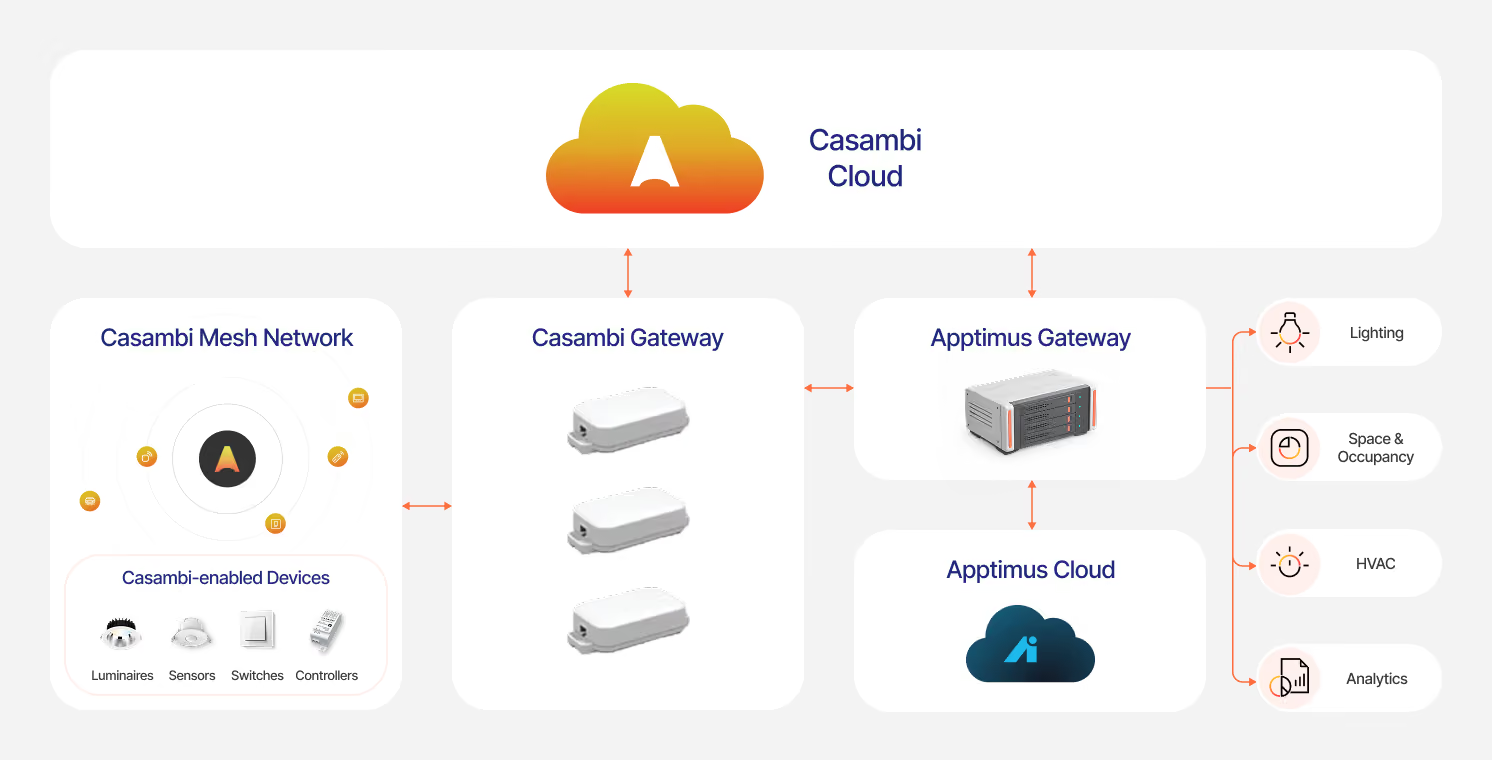
This wireless architecture also makes the solution scalable. Multiple Casambi gateways can be installed across different floors, buildings, or entire campuses, allowing the lighting network to expand as operational needs grow.
Another important aspect is how the integration handles cloud connectivity. The Casambi Cloud is required during the initial setup and configuration, as well as when the network is recommissioned. Once commissioning is complete, the Apptimus Gateway communicates directly with the on-premise Casambi gateways, allowing the lighting system to operate locally without relying on the cloud.
Together, Apptimus and Casambi bring lighting control into a connected building environment, where lighting can respond to real-time workplace activities while remaining centrally monitored and managed.
Several developments at this year's event reflect how the lighting industry is evolving. Three shifts are particularly relevant to commercial buildings and enterprise facilities.
Upgrading existing lighting infrastructure can be complicated, particularly in large commercial buildings where replacing wiring or modifying existing systems can increase project costs and disruption.
Wireless lighting control offers another approach. By enabling communication between lighting devices and control systems without relying entirely on new control wiring, it can provide greater flexibility during installation and future expansion.
This is particularly relevant as retrofit installations gain momentum across the Asia Pacific smart lighting market. Organisations are increasingly looking for ways to modernise existing buildings while making better use of their current infrastructure.
As buildings adopt more connected technologies, the ability of different systems to communicate is becoming increasingly important.
Lighting systems need to work alongside sensors, building management systems, energy platforms and other operational technologies. A solution that operates only within one manufacturer's ecosystem may create limitations when organisations want to expand or integrate additional systems.
This makes communication protocols, integration capabilities and system compatibility important considerations when evaluating connected lighting solutions.
For enterprise facility teams managing multiple buildings, interoperability can also influence long-term flexibility. It allows organisations to evaluate technology based on operational requirements rather than being restricted to a single hardware ecosystem.
Human-centric lighting and adaptive illumination received attention at this year's fair. The focus is shifting towards lighting that can respond to the requirements of different spaces, activities and occupants.
In commercial environments, this can include adjusting brightness based on daylight availability, using occupancy signals to control lighting in meeting rooms and common areas, and creating different lighting schedules for different zones.
These applications bring lighting closer to the everyday operations of a workplace. Rather than following fixed schedules everywhere, lighting systems can respond to how spaces are actually being used.
The result is an opportunity to improve operational efficiency while creating more adaptable environments for building occupants.
The growing adoption of connected lighting is part of a wider transformation in commercial buildings. As organisations invest in smarter infrastructure, the focus is moving towards understanding how individual building systems influence one another.
Consider a commercial office with multiple floors, meeting rooms and shared workspaces. Occupancy information can help determine which areas require lighting, while energy monitoring can highlight zones with unusually high consumption. When this information is available alongside other facility data, teams gain better visibility into how their buildings operate.
This is where facility intelligence becomes relevant.
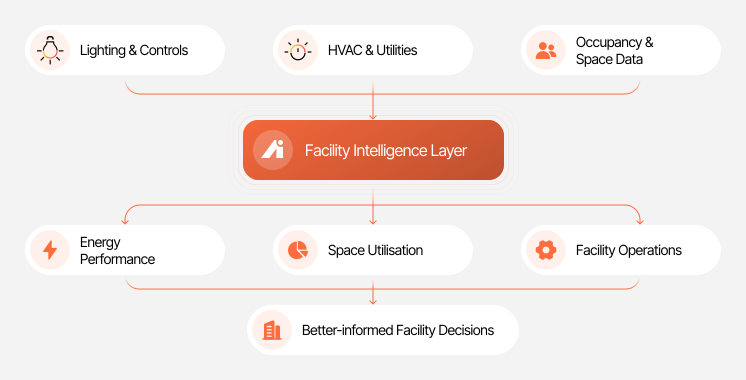
The value is not simply having more data. It is being able to understand what that data means in the context of the building and use it to make better operational decisions.
For organisations managing large or geographically distributed portfolios, this becomes even more important. A unified intelligence layer can help establish greater visibility across facilities, identify operational patterns and support more consistent management practices.
The Hong Kong International Lighting Fair 2026 reinforced an important shift in the industry: the future of lighting will be shaped not only by how efficiently we illuminate spaces, but by how intelligently those spaces respond to changing needs.
Wireless control, interoperability and adaptive lighting are becoming important considerations for organisations planning their next generation of commercial buildings and workplaces.
Our participation alongside Casambi gave us an opportunity to be part of this evolving industry conversation and highlight the connection between lighting automation and broader facility intelligence.
As buildings become more connected, the opportunity is to bring their systems together in ways that make facilities more efficient, responsive and intelligent.
We thank Casambi for the partnership and look forward to continuing the conversation around the future of connected lighting.
Privacy is important to us, so you have the option of disabling certain types of storage that may not be necessary for the basic functioning of the website. Blocking categories may impact your experience on the website. More information

