Any facility.
Complete intelligence.


Learn how smart visitor management systems eliminate front-desk bottlenecks, verify visitor identity, and produce audit-ready records automatically.


Most organizations already have a process for managing visitors. The question becomes more complicated as the workplace grows. A process that works well for one office may become harder to manage across multiple sites, access points, visitor types, and security requirements.
The real challenge is not simply replacing a paper logbook with a digital check-in screen. It is understanding how much of the visitor journey your current setup actually handles, where manual gaps still exist, and whether visitor information can connect with the systems your facilities and security teams already rely on. That is where the difference between basic digital check-in and a smarter, more connected visitor management approach starts to matter.
A smart visitor management system is a connected platform that handles the full visitor lifecycle, from digital pre-registration and host notification through check-in, real-time tracking, and departure, while integrating that data with your existing facility, access-control, and workplace infrastructure.
That definition is worth having. But the more useful question for most enterprise teams is whether what they currently have actually qualifies.
Most organizations have something. A logbook, a kiosk, maybe a digital check-in tool at the main reception. The honest problem is that "something" and "enterprise-ready" are not the same thing, and the gap between them tends to show up in the moments that matter most: a security audit, a multi-site policy rollout, or a visitor who walked into the wrong area because no one was tracking movement in real time.
Before the maturity framework below, a quick diagnostic:
Does your current setup do these four things?
- Visitor records are searchable, time-stamped, and consistent across every site in your portfolio
- Hosts receive automatic notification when their guest arrives, without front-desk intervention
- Your team can report, at any moment, exactly who is inside any building in your estate
- Your visitor check-in process connects with access control, not just records a name
If any of those land as "not really," the rest of this article is where to start.
Facility and workplace teams rarely choose to stay at an early maturity stage. They just get busy, and whatever is in place continues until a trigger, a compliance requirement, a security incident, a new site acquisition, forces a harder look. CBRE research found a 37% increase in goals dedicated to enhancing the workplace experience in 2024 (CBRE, 2024), which suggests those triggers are arriving more frequently.
The maturity ladder below is designed to help you locate yourself honestly, without requiring a vendor conversation to do it.
| Stage | What you can do | What you cannot do | Typical trigger to move on |
|---|---|---|---|
| Logbook | Record a visitor's name and arrival time | Search records reliably, enforce policy, prove who was on-site during an incident | Security audit or compliance review |
| Digital check-in | Capture visitor data digitally, print a badge, notify the host manually or by email | Report consistently across sites, connect visitor data to access control or facility systems | New site opens with different process; IT flags data risk |
| Connected visitor management | Pre-register visitors, automate host alerts, track in real time, log departure, integrate with access control and workplace platforms | Contribute visitor data to occupancy analytics, space planning, or facility workflows | Lease renewal, portfolio expansion, or ESG/audit requirement |
| Facility intelligence | Use visitor and occupancy data together across the platform; surface patterns that inform space, energy, and operations decisions | — | Ongoing; the platform evolves with the organisation's data needs |
Most enterprise organizations sit at stage two. They have digital visitor check-in at some sites and a logbook or ad hoc process at others. The result is a visitor records landscape that is neither searchable nor consistent, and a security posture that depends on which building a visitor happened to enter.
Stage three is where visitor registration stops being a front-desk task and starts being a connected workflow. The visitor's arrival triggers events in other systems: a host notification, a temporary access credential, a record that becomes part of the building's occupancy picture. That connection is what separates a digital visitor management system from a genuinely smart one.
Stage four, facility intelligence, is where visitor data contributes to a broader operating model. Occupancy management decisions, space planning, cleaning schedules, energy use: all of these become more accurate when visitor patterns are part of the dataset rather than sitting in a separate siloed system.
The honest limit of this framework is that moving between stages is rarely a single clean decision. Many organizations run two or three stages simultaneously across a portfolio, with flagship offices at stage three and regional sites still using a tablet app disconnected from everything else. Knowing that is useful, because it means the upgrade path is often less about replacing everything and more about closing specific gaps.
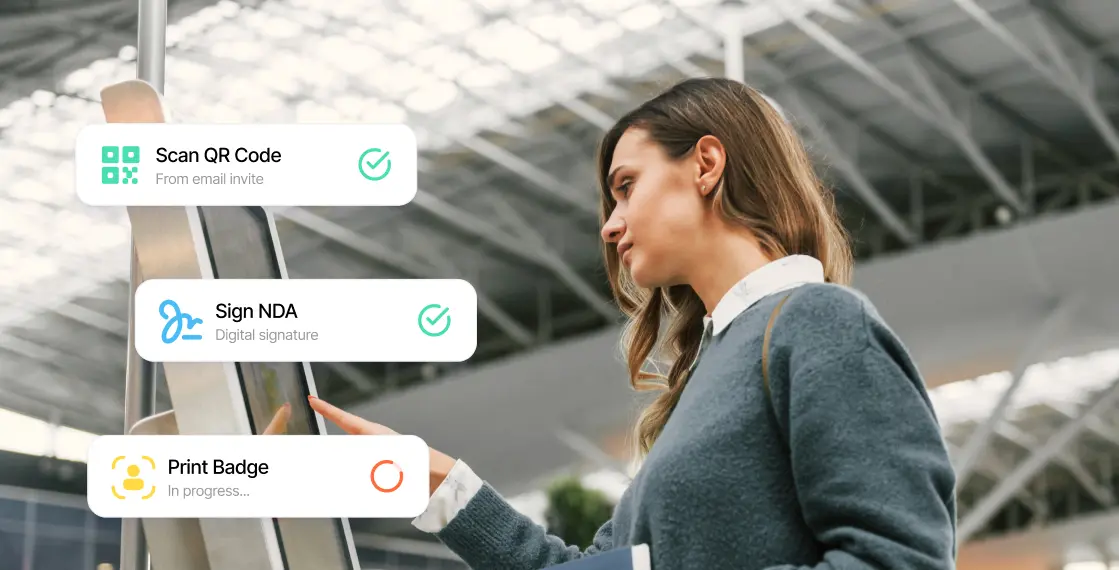
At the connected maturity stage, visitor management is a workflow rather than a moment. Each step captures data, and that data connects to at least one other system.
What this flow gives the organization is not just a tidy visitor experience. It is an auditable, searchable record of every visit, with timestamps at each stage and integration points that make the data useful beyond reception.
A point solution records a visit. A connected platform makes that visit useful. The distinction matters because most enterprise organizations already have some form of visitor management software in place, and the question they are actually asking is whether what they have is doing enough.
The short answer is that standalone digital check-in solves the front-desk problem. A connected platform solves the enterprise problem. Over 80% of organizations now integrate their workplace technology tools using APIs or a data warehouse (CBRE, 2024). That number suggests that the organizations setting the standard for workplace operations have already decided integration is not optional.
| Capability | Standalone digital check-in | Connected visitor management platform |
|---|---|---|
| Multi-site consistency | Each site configures its own process; policies drift | Single policy framework applied across all sites from one admin layer |
| Access-control integration | Visitor check-in is logged separately from access events | Check-in triggers access credentials scoped to permitted areas |
| Real-time visibility | Reception desk can see who is in; no central view | Any authorized team member can see who is on-site across all buildings |
| Reporting and audit trail | Per-site exports, manually compiled | Consolidated, searchable records across the portfolio on demand |
| Workflow automation | Badge printing is a manual step after check-in | Arrival events trigger downstream workflows automatically |
The integration layer is where the real difference lives. When visitor check-in connects to calendar systems, HR directories, and visitor management software that sits inside a broader facility platform, the data stops being a reception record and starts informing decisions. Occupancy patterns become visible. Cleaning and catering workflows respond to actual arrivals rather than scheduled assumptions. And lighting management solutions, for example, can respond to occupancy signals that now include visitor presence, not just employee badge-ins.
Security improvements from a connected visitor management system are not primarily about surveillance. They are about replacing assumptions with evidence.
When a visitor's identity is verified at pre-registration, matched at arrival, and connected to a scoped access credential, the organization can demonstrate site control rather than describe its intentions around it. That demonstration matters when a security review, a safety incident, or an audit asks exactly who was in a specific area at a specific time.
68% of organizations say they plan to implement AI in visitor management within the next 12 months, specifically to improve safety integrations and automated check-in capabilities (IFMA FMJ, The Cost of Fragmentation). The direction of travel is toward systems that do more of the security work automatically, rather than leaving it to front-desk judgment.
The specific capabilities a connected platform enables for security and compliance teams:
Each of these capabilities supports the organization's own compliance and safety requirements. The platform does not hold any specific certification on behalf of a client; it gives the team the data and controls they need to demonstrate compliance with their own obligations.
Any vendor can describe their platform as enterprise-ready. The checklist below gives a buying committee a way to test that claim with specific questions, applied consistently across every option under evaluation, including whatever is currently in place.
| Criterion | What good looks like | Question to ask any vendor |
|---|---|---|
| Enterprise scalability | Consistent behavior across 10 or 50 sites without bespoke configuration at each | Can you show us how policy changes propagate across all sites simultaneously? |
| Integration without disruption | Connects with existing access control, calendar, HR, and facility systems; does not require infrastructure replacement | Which access-control and HR systems do you have live integrations with today? |
| Visitor and host experience | Pre-registration, check-in, and host notification are simple on mobile and kiosk; minimal front-desk involvement | Walk us through the visitor journey from invitation to departure on a mobile device |
| Data security and privacy | Visitor data is handled in line with the organization's own security and privacy requirements; deployment options support data residency needs | What are your cloud, on-premises, and hybrid deployment options, and how is visitor data isolated per tenant? |
| Multi-site visibility | Central dashboard shows real-time occupancy across all locations; reporting is consolidated, not compiled manually | Can your reporting show us a live view of visitors across all our sites in a single screen? |
| Deployment flexibility | Cloud, on-premises, or hybrid; supports the organization's infrastructure and data governance requirements | How do you handle customers who need on-premises deployment at some sites and cloud at others? |
| Audit trail and reporting | Searchable, time-stamped records for every visit; exportable on demand without manual extraction | How long are visit records retained, and can we export a complete audit log filtered by site, date, and visitor type? |
| Platform fit | Visitor management works as a standalone capability today and connects to broader workplace, space, and facility data as needs grow | If we expand to include space management or occupancy analytics later, does visitor data integrate with those capabilities natively? |
That last criterion is worth sitting with. A visitor management platform that is genuinely useful at enterprise scale tends to be a capability within a broader facility intelligence system, not a separate product bolted alongside one. Apptimus is designed on that principle: visitor management is one of twenty-three capabilities on a single platform, which means the visitor data already speaks to space, occupancy, and facility workflows rather than sitting in its own silo.
The maturity journey from a logbook to a connected guest management system is not a technology story. It is a question of what the organization wants to be able to know, and when.
Digital visitor check-in is a solved problem. The harder work is making visitor data genuinely useful: connected to access control, visible across sites, and contributing to the occupancy picture that drives better decisions about space, energy, and operations.
If the checklist above surfaced gaps in your current setup, or if the maturity framework placed your organization at a stage that no longer fits where the portfolio is heading, the practical next step is a conversation rather than another evaluation document.
Bluecoin IoT built Apptimus for exactly this kind of situation, where visitor management is one piece of a larger facility intelligence problem, not a standalone product to be bolted on later. If you want to see how the gaps in your current setup map to what Apptimus handles across its twenty-three capabilities, a specialist can walk through your specific situation and show you where the connections already exist.
A visitor management system is a platform that handles the full lifecycle of a visit, from pre-registration and host notification through check-in, real-time tracking, and departure logging. At the connected maturity stage, it integrates that data with access control, calendar, and facility infrastructure rather than keeping it as a standalone reception record.
The visitor receives a pre-registration link from the host, completes their details before arrival, and checks in on arrival via kiosk or mobile. The system matches them to their existing record, issues a badge, notifies the host, and, where access control is connected, activates a scoped temporary credential. Departure is logged as a data event, not assumed.
It removes the coordination work from the front desk. Hosts receive automatic arrival alerts, visitor records are created before anyone walks in, and badge printing happens without manual input. Reception staff spend less time on administrative check-in steps and more time on exceptions that actually need human judgment.
Visitor identity is verified at pre-registration, matched at arrival, and connected to access credentials that expire automatically. The platform maintains a live record of who is on-site and in which zone, and produces a time-stamped audit trail that can be exported without manual compilation. Security teams work from evidence rather than estimation.
The core workflow, pre-registration, digital check-in, host notification, and departure logging, applies across hospitality contexts such as hotel business centers, conference venues, and managed workspaces. The platform configuration differs: visitor categories, access zones, and badge formats are all adjustable to suit environments where guests are not employees and the volume of unscheduled arrivals is higher.
The host initiates a visit through the platform, entering the visitor's name, contact details, and purpose. The visitor receives a confirmation with check-in instructions and any required documents. On the day, check-in matches the person to the existing record rather than capturing details from scratch at the desk.
Each visit generates a time-stamped record covering pre-registration details, arrival time, check-in method, badge issuance, access areas entered, and departure. Records are searchable, consolidated across sites, and exportable on demand, making them available for security reviews, safety incidents, or audit requirements without any manual compilation.
Privacy is important to us, so you have the option of disabling certain types of storage that may not be necessary for the basic functioning of the website. Blocking categories may impact your experience on the website. More information