Any facility.
Complete intelligence.


Explore 8 facility management best practices to build scalable operations, improve efficiency, connect data, and make smarter portfolio-wide decisions.


Most facility programs have good intentions built into them. There are checklists somewhere, a ticketing system of some kind, people who genuinely care about the buildings they manage. What they often lack is a foundation sturdy enough to hold all of that effort together when a portfolio grows beyond one or two sites.
The operational pain shows up predictably. Maintenance teams respond to failures rather than preventing them. Processes that work reasonably well at one site get reinvented at the next. Data sits in disconnected systems — a building management system here, a spreadsheet there, a service request management tool that only three people know how to use, and no one at the portfolio level can see what's actually happening across all of it.
The pattern worth naming: FM programs rarely fail because people aren't trying. They stall because the structural discipline underneath the effort was never built.
That distinction matters, because it changes what the solution looks like. A new checklist won't fix a reactive maintenance culture. A dashboard won't fix siloed systems. The best practices that follow in this article are about that structure, not the surface layer on top of it.
Facility management best practices are the repeatable, measurable disciplines that keep a building running well for the people inside it and the business that owns it. The scope is wider than most FM teams are given credit for managing, and that gap in recognition tends to follow the function for years.
Maintenance is the obvious starting point, but it sits alongside energy stewardship, space utilization, regulatory compliance, asset lifecycle management, and occupant experience. These aren't separate programs. They're interconnected, and treating them as separate is part of why FM often gets positioned as a cost center rather than a strategic function.
| FM domain | Business outcome |
|---|---|
| Preventive maintenance | Fewer unplanned failures; lower repair costs over time |
| Asset management | Extended asset life; accurate capital planning |
| Space utilization | Right-sized real estate; lower occupancy cost |
| Energy management | Reduced utility spend; ESG reporting readiness |
| Regulatory compliance | Audit confidence; reduced liability exposure |
| Occupant experience | Retention, productivity, and workplace trust |
The breadth of this is exactly why data-driven facility management has become a real discipline rather than a buzzword. According to JLL's Global State of Facilities Management report, 28% of organizations have now embedded AI solutions into their FM operations, a sign that the function is maturing past manual oversight. The other 72% are still figuring out where to start, and for most of them, the answer isn't a single technology. It's a clearer picture of what effective facility management actually requires, across all six domains, before any tool is selected.
The gap between an FM program that works at one site and one that scales across a portfolio is almost always structural, not motivational.
About 70% of FM teams still track maintenance expenditures in Excel or manual spreadsheets, according to IFMA research. That number is striking less for what it says about technology adoption and more for what it reveals about data portability: information that lives in a local spreadsheet cannot surface a portfolio-wide pattern, support a compliance audit, or give leadership anything to benchmark against.
The plateau is structural, not motivational — and it tends to announce itself through recognizable symptoms.
Common plateau signals
The IFMA data points to something else worth sitting with: 54% of all maintenance costs go toward preventive maintenance, which means most organizations are already spending on prevention. The question isn't whether to invest in preventive maintenance. It's whether that investment is generating consistent, auditable, scalable results, or just recurring effort that looks like progress without building toward anything.
Improving facility management at the portfolio level means making that effort visible, comparable, and improvable across every site. The sections that follow are about how.
Effective facility management is built on disciplines that can survive a change of site, a change of team, and a change of leadership. The eight practices below are the ones that show up consistently in programs that scale, listed roughly in the order a team building from scratch would encounter them.
Most maintenance schedules are built around time intervals, every 30 days, every quarter, because time is easy to track. The problem is that equipment doesn't degrade on a calendar. A chiller running at higher-than-usual load needs attention sooner than one sitting in a mild climate doing light work.
The best practice here is to move toward condition-based and eventually predictive maintenance, where sensor data or usage patterns trigger work orders rather than a date on a spreadsheet. This is what separates a building maintenance program that prevents failures from one that simply records them after the fact. Predictive maintenance adds a layer of analysis, using historical patterns to flag when failure probability crosses a threshold, so work order management becomes a response to evidence rather than assumption.
An asset register that only tells you what you own is a filing system. Genuine asset management tells you what each asset costs over its lifetime, when it is likely to need replacement, and how its performance is trending. That information is the foundation of capital planning, and without it, FM teams are guessing at budget requests rather than building them from data.
Good asset lifecycle management connects maintenance history, warranty status, and performance data in one place. It makes the case for replacement versus repair something you can calculate rather than argue.
Standardized inspection and maintenance checklists are unglamorous and genuinely important. They are the mechanism that makes a multi-site FM program auditable. When every site runs a different version of a routine inspection, you cannot compare results, identify systemic issues, or demonstrate compliance to an auditor without manually reconciling data from a dozen different formats.
The discipline here is agreeing on what "done correctly" looks like before rolling any process out. Digital checklists enforce that standard at the point of execution, and they generate a timestamped audit trail that a spreadsheet cannot.
Energy management is sometimes treated as a sustainability initiative rather than a facility management function. The distinction costs money. Buildings account for a significant share of any enterprise's operating expenditure, and the gap between a building running at its designed efficiency and one running with no monitoring at all is typically visible in the utility bill long before anyone investigates.
Building automation systems (BMS) can control HVAC and lighting, but the insight layer sits above them. Real-time monitoring of energy consumption, indoor air quality, and equipment efficiency turns energy from a fixed cost into a manageable one, and it generates the data that ESG reporting now requires.
Space management has become a central facility management concern precisely because occupancy patterns changed and nobody's intuition kept up. Desks that look occupied may be reserved but empty. Meeting rooms booked for an hour may be used for fifteen minutes. Without actual occupancy data, decisions about whether to expand, consolidate, or redesign space are made on assumption.
Workplace management improves measurably when occupancy data is visible and current. Desk booking systems and space sensors generate the usage patterns that let FM and real estate teams make cases to leadership that rest on evidence rather than headcount projections.
Data-driven facility management is not a technology choice; it's an organizational posture. It means that when something goes wrong, the first question is "what does the data show?" rather than "who do we call?" It means KPIs are set, tracked, and reviewed at a portfolio level, not just at individual sites.
Facility management KPIs worth tracking at a portfolio level typically include planned versus reactive maintenance ratios, average time to resolve service requests, energy consumption per square meter, space utilization rates by floor or building, and asset uptime. These metrics make FM performance visible to leadership in terms they recognize, which is how the function earns budget and credibility.
Compliance and sustainability goals are increasingly part of the same conversation. ESG reporting requires data about energy consumption, water use, and indoor environmental quality that FM teams already have access to, provided the systems collecting it are connected and the data is clean. Regulatory compliance, whether fire safety inspections, air quality standards, or site access controls, requires the same kind of structured, auditable workflow.
Building compliance into the daily fabric of facility operations, through checklists, alerts, and documented work orders, means an audit is never a scramble. The records exist because the work was done correctly and recorded in real time, not because someone reconstructed events before an inspection.
The people inside a building are the reason facility management exists. Occupant experience is sometimes treated as a soft outcome, harder to quantify than energy savings or maintenance costs. It is measurable. Response time to service requests, resolution rates, temperature comfort complaints, air quality readings, and parking availability are all data points that reflect how well a facility serves the people using it.
Programs that track these metrics and act on them create a feedback loop between FM operations and occupant satisfaction. Business continuity planning depends on facilities that people trust enough to return to and work productively in.
| FM domain | Reactive approach | Best-practice approach |
|---|---|---|
| Maintenance | Fix on failure | Preventive and predictive schedules |
| Asset management | Track ownership | Track lifecycle and cost |
| Checklists | Site-specific, informal | Standardized, digital, auditable |
| Energy | Monitor utility bills | Real-time BMS and IoT monitoring |
| Space | Plan from headcount | Plan from occupancy data |
| Decision-making | Experience-based | KPI and data-driven |
| Compliance and ESG | Reactive to audits | Built into daily operations |
| Occupant experience | Anecdotal feedback | Structured, tracked, measured |
The distance between the reactive column and the best-practice column is mostly a data problem. Facilities that have moved across tend to have one thing in common: sensors and systems that surface what is actually happening, rather than what someone last remembered to check. Bluecoin IoT sits in that gap, connecting asset conditions, occupancy patterns, and energy readings into a single view that planners can act on without waiting for the monthly report.
The most common reason FM improvement stalls is not disagreement about what good looks like. It is the feeling that getting there requires a complete overhaul, and that a complete overhaul is not something anyone has the budget or the appetite to approve.
A phased approach makes the gap smaller and the case easier to build.
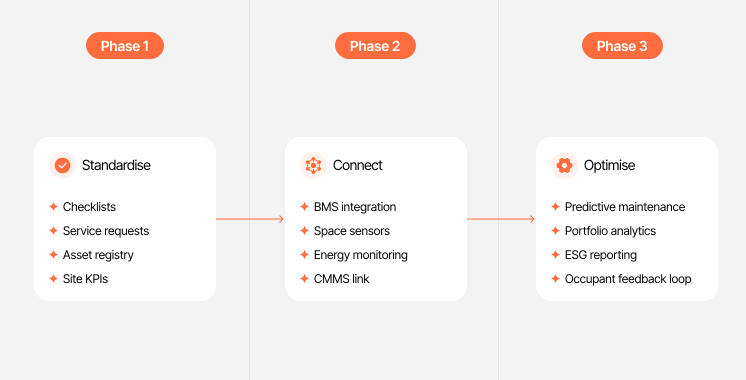
Three phases of FM improvement: build the standard, connect the data, then optimize across the portfolio.
Phase one is about standardization. Before any integration or analytics layer is useful, the underlying processes need to exist in a consistent, documented form. Checklists, work order management workflows, asset registers, and site-level KPIs. This phase doesn't require new technology to get started; it requires agreement on what good looks like.
Phase two is about connection. Once processes are standardized, the next step is linking the data they generate. A facility intelligence platform that sits above existing infrastructure, connecting BMS systems, space sensors, and service request tools without requiring a rip-and-replace of what already works, is how most mature FM programs bridge the gap between disconnected systems and portfolio-level visibility. The IFMA research on FM data capabilities identified six key insights about how organizations move from siloed data to connected operations, and the consistent finding is that the connection layer is more valuable than any individual system it links.
Phase three is optimization. With standardized processes and connected data, the conditions exist for predictive maintenance, real-time energy optimization, space consolidation decisions based on actual usage, and ESG reporting that draws from operational data rather than estimates. Facilities management improvement strategies that try to begin here, at optimization, before the earlier phases are in place, tend to produce dashboards that display data nobody trusts enough to act on.
The phases are sequential because the value of each one depends on the one before it. Starting in phase one also means the early wins are visible and documentable, which is usually what a leadership team needs to approve the next stage of investment.
Bluecoin IoT is built for this progression. Its sensor network handles the real-time data collection that phase one requires, its platform connects those data streams across systems as processes standardize, and its analytics layer gives facilities teams the usage and performance insight that makes phase three decisions defensible rather than approximate.
Six metrics give FM directors and CRE leads the clearest picture of portfolio health, and they also happen to be the ones finance and leadership can understand without a facilities background. According to JLL's Global State of Facilities Management report, 81% of respondents identify cost efficiency and budget optimization as a leading priority for the coming year. Measurement is how you show progress against that priority in terms a CFO will read.
| KPI | What it measures | Target benchmark | How to use it |
|---|---|---|---|
| Planned maintenance compliance rate | Percentage of scheduled work orders completed on time | 90%+ | Tracks whether preventive maintenance is actually happening, not just scheduled |
| Mean time to repair (MTTR) | Average time from fault reported to fault resolved | Varies by asset class; set internal targets | Benchmarks work order management efficiency across sites |
| Energy use intensity (EUI) | Energy consumed per square foot or square meter annually | Sector benchmarks via ENERGY STAR | Flags underperforming buildings and supports ESG reporting |
| Space utilization rate | Percentage of available space in active use | 70–80% for most office environments | Informs real estate decisions; surfaces consolidation opportunities |
| Occupant satisfaction score | Survey or service-request feedback rating | 80%+ positive | Connects FM operations to workplace experience outcomes |
| Cost per square foot | Total FM spend relative to managed area | Industry median varies by sector | Supports leadership reporting and year-on-year budget conversations |
The numbers are only useful when reviewed at a portfolio level and compared across periods. A single site's MTTR tells you how that team performed last month. The same metric across twenty sites tells you where your processes are consistent and where they are not.
Facility management is the function responsible for the performance, safety, and efficiency of the built environment that a business operates in. It covers maintenance, energy, space, compliance, and occupant experience, and at mature organizations it operates as a strategic function rather than a purely operational one.
Facility management services are the specific disciplines delivered under the FM umbrella: preventive and corrective maintenance, cleaning, space management, asset tracking, energy monitoring, visitor management, and regulatory compliance support. These can be delivered in-house, outsourced, or through a hybrid model.
Improvement follows a sequence. Standardize processes across sites first, then connect the data those processes generate, then use that connected data to optimize. Trying to optimize before the earlier steps are in place tends to produce reports that teams don't trust enough to act on.
The most useful business intelligence for FM is the kind embedded in daily operations rather than built separately. A facility intelligence platform that connects BMS data, space sensors, service requests, and asset records gives teams real-time visibility and portfolio analytics without requiring a separate reporting layer that someone has to maintain manually.
The framework above is a starting point, not a prescription. Every portfolio has different constraints, different legacy systems, and different organizational appetites for change. What tends to be consistent is where the value shows up first: in maintenance workflows that stop generating surprises, in energy data that justifies decisions, in space usage that reflects how people actually work. The Apptimus facility intelligence platform is built to sit above your existing infrastructure and connect those disciplines without asking you to replace what already works. For teams managing operations across multiple regions, including the growing footprint of global capability centers in India, the path from standardization to optimization is one worth starting sooner rather than waiting for the perfect conditions that rarely arrive.
Privacy is important to us, so you have the option of disabling certain types of storage that may not be necessary for the basic functioning of the website. Blocking categories may impact your experience on the website. More information